
What Does This Make Possible?
In Generative Relationships STAR, participants assess their team's attributes using a STAR Compass to understand what makes their relationships more or less generative. By identifying patterns in their interactions, they can find opportunities for improvement, create new value, and heal damaged relationships. This structure brings to life LS Principle #5, Practice Self-Discovery Within a Group.
Structural Elements — Min Specs
-
Structuring Invitation
"Together, we'll explore the dynamics of our team's relationships using the STAR Compass. By understanding what makes our interactions more or less generative, we can unlock hidden potential and build stronger connections."
-
Space and Materials
An open wall with a STAR Compass template (from online resources or draw your own) and space to move around. Groups of four to seven chairs around small tables [breakouts of four to seven]. Copies of the template for each small group on a flip chart [in a visual collaboration space]. Template handouts, paper, and pens for each F2F participant.
-
Participation Distribution
Roles include host [tech host] and participants. There is no minimum group size. Everyone in the working group or team is invited and has an equal opportunity to contribute.
-
Group Configuration
When people work alone, in small groups, or as a whole group, plus breakout-room logistics for online meetings. In F2F gatherings, hosts may join small groups. In online meetings, we assume hosts and tech hosts stay in the main room and do not join breakouts.
-
Steps and Time Allocation
- ► Intro: Share the structuring invitation and hand out the template [have participants draw their own STAR Compass]. (1 min.) (1)
- ► Individual Reflection: Each participant assesses the team on the four elements of the STAR Compass and places a dot on each axis by asking: - How diverse are our group and perspectives? (Separateness) - How well are we in tune with each other? (Tuning) - How much do we act together? (Action) - How important is it that we work together? How clear is our purpose? (Reason to Work Together) (4 min.) (4)
- ► Form Groups and Share: Participants form groups of four to seven [breakouts] and each place their dots on a shared STAR Compass. They discuss similarities and differences in their placements. (5 min.) (5)
- ► Identify Results: In small groups, participants identify what results these compass points produce when combined and record the outcomes. Examples include: - High T + No A = We get along well but accomplish little - High A + Low T = Routine results with no innovation - High T + High S + High A + Low R = Many false starts (5 min.) (5)
- ► Brainstorm Action Steps: Each small group brainstorms actions to boost elements that need attention and record their ideas. (5 min.) (5)
- ► All-Together Sharing: Everyone returns to plenary and compares the assessments and action steps. Ask a few people to reflect on what first steps make sense for the group and record ideas [use Chatterfall]. (5 min.) (5)
Diagrams & worksheets
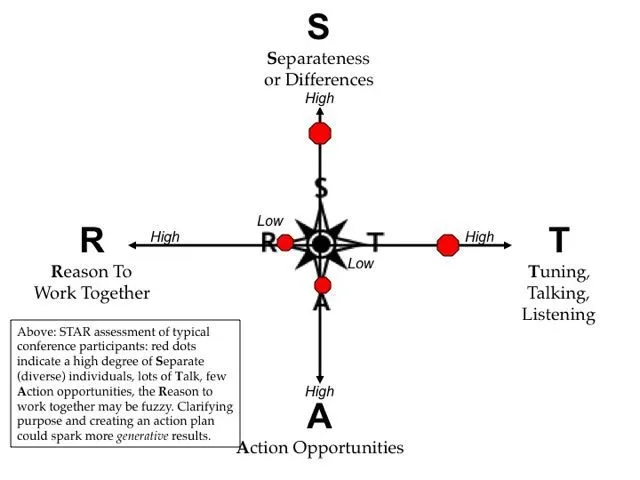
Diagram: Liberating Structures, Henri Lipmanowicz & Keith McCandless, liberatingstructures.com, CC BY-SA 4.0
Tips & Pitfalls
- Avoid judging whether people's assessments of the team are right or wrong. Finish with at least one action step.
- Make sure it's clear to all who will do what by when.
- Focus on interaction patterns, not on individuals. This makes it safe to be honest.
- Give participants time for individual reflection. Those minutes are essential — don't skip them.
Riffs & Variations
- Use Generative Relationships STAR to explore personal patterns with revised compass points: What do you bring to the group that might be different? To what degree do you reflect on your personal experience? Are you creating self-development opportunities to act on insights? To what degree are you clear on the purpose of your work?
- Chain with complementary structures targeting specific compass points: Separateness (Conversation Café, W3), Tuning (Troika Consulting, HSR), Action (15% Solutions, Open Space), Reason (9 Whys, Drawing Together).
Practical Applications
- Focus attention on group dynamics during a strategy retreat.
- Support an organization making a cultural transition toward more inclusion, engagement, or grassroots innovation.
- Help two people identify dysfunctional patterns and mend their relationship.
- Help a new team build a strong foundation for collaboration.
- Gain insight into interaction patterns within interdisciplinary teams.
Online & Hybrid Facilitation
This structure works online with no major adjustments. Use a digital whiteboard (Miro, MURAL) with a STAR Compass template for shared visualization. Participants place digital stickers or markers on their individual compass, then in breakouts on a shared compass. The host stays in the main room and does not join breakouts.
Combining with Other Structures
String together with Liberating Structures that may boost specific compass points, such as Separateness (Conversation Café, W3), Tuning (Troika Consulting, HSR), Action (15% Solutions, Option Place, Min Specs), or Reason (9 Whys, Drawing Together).
Combine with Other Structures
Sources & License
Developed by professor Brenda Zimmerman. Adapted by Henri Lipmanowicz and Keith McCandless. Dig deeper by exploring the work of Brenda Zimmerman and the Plexus Institute: http://www.plexusinstitute.com/edgeware/archive/
Based on the work of Keith McCandless and Nancy White, The Liberating Structures Fieldbook (2026), CC BY-SA 4.0.

Learn this in practice
Practice Liberating Structures with others: in the Online Fieldbook series (Nov–Dec 2026), the Immersion in Brussels, or tailored for your team.