
What Does This Make Possible?
In Agreement and Certainty, participants sort problems into four categories—simple, complicated, complex, or chaotic—and look for mismatches between problems and solutions. This helps us align solutions with the complexity of the problems we face and prevents wasting resources on the wrong kind of solution. Artfully layering challenges and mismatches will sharpen next steps and new strategies. This structure brings to life LS Principle #10, Never Start Without Clear Purpose(s).
Structural Elements — Min Specs
-
Structuring Invitation
"Let's get strategic about matching our approaches to our challenges! We'll use a simple framework to categorize our challenges and identify any mismatches between them and our current approaches to addressing them. This will help us select more effective solutions and make progress."
-
Space and Materials
Groups of four to six chairs at small tables. Matrix figures displayed for all. Copies of the blank matrix for each participant. Sticky notes and markers.
-
Participation Distribution
Roles include host (tech host for online), and participants. There is no minimum group size. Everyone involved in the team or unit under discussion (not only leaders) is invited and has an equal opportunity to contribute.
-
Group Configuration
Alone, small groups, whole group
-
Steps and Time Allocation
- Intro: Share the structuring invitation. Display and explain the four types of challenges. (3 min.)
- List Challenges: Participants individually list challenges they are facing. (2 min.)
- Form Groups and Compare Lists: Participants form groups of four to six to compare their lists and create a shared list of common challenges. (3 min.)
- Introduce Agreement-and-Certainty Matrix: Hand out copies of the matrix. Provide examples from your context for each category—something simple (like following a recipe), complicated (like sending rockets to the moon), complex (like raising children), and chaotic (like pinning the tail on the donkey). (3 min.)
- Categorize the First Challenge: Each small group chooses a challenge and places it on the matrix based on their answers to these questions: What is our degree of agreement regarding the complexity of the challenge? What is our degree of certainty or predictability about the results it will generate? (5 min.)
- Categorize Remaining Challenges: Groups place the rest of their challenges on the matrix following the same process. (5 min.)
- Dig Deeper: Each group picks one important challenge from their list and lists their current approaches to address it. (3 min.)
- Explore Fit: Each group explores the fit between the challenge type and their current approach, identifying mismatches using provided guidelines. (15 min.)
- All-Together Sharing: Everyone returns to plenary. Each group posts their challenges and mismatches on a large copy of the matrix; then everyone reflects on the patterns they see. (10 min.)
Diagrams & worksheets
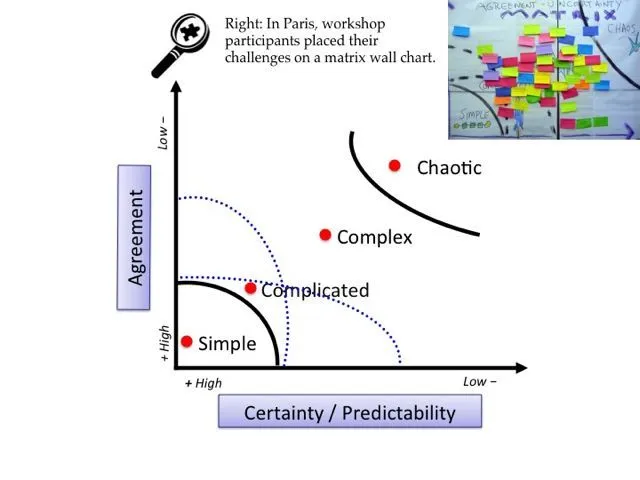
Diagram: Liberating Structures, Henri Lipmanowicz & Keith McCandless, liberatingstructures.com, CC BY-SA 4.0
Tips & Pitfalls
- Encourage everyone to avoid making judgments about where people place their activities.
- If participants spend too much time defining the challenge rather than focusing on how to address it, redirect them to focus on how to address the challenge.
Riffs & Variations
- Have participants hold up signs for Chaotic, Complex, Complicated, or Simple to indicate their level of agreement visually.
- Create a table to capture mismatches and action steps for addressing them.
- Immediately following this structure, use the LS Selection Matchmaker to identify ways to address complex challenges.
Practical Applications
- Help managers understand chronic challenges.
- Help a planning group move from analysis paralysis to action.
- Organize a department's project portfolio.
Online & Hybrid Facilitation
This works online with no major adjustments.
Combining with Other Structures
String mismatches with DAD, Panarchy, or Strategy Knotworking to generate more local prototypes.
Combine with Other Structures
Sources & License
Liberating Structure developed by Henri Lipmanowicz and Keith McCandless. Dig deeper by exploring the work of professor Brenda Zimmerman and the Plexus Institute: http://www.plexusinstitute.com/edgeware/archive/
Based on the work of Keith McCandless and Nancy White, The Liberating Structures Fieldbook (2026), CC BY-SA 4.0.

Learn this in practice
Practice Liberating Structures with others: in the Online Fieldbook series (Nov–Dec 2026), the Immersion in Brussels, or tailored for your team.