
What Does This Make Possible?
In Integrated~Autonomy, participants look for opportunities to boost central integration with local autonomy. It centers on two wicked questions: "What mix of integration and freedom will advance our purpose?" and "How can we balance global consistency with local customization?" By learning to view these as complementary forces, we can maintain flexibility in local groups while working within centrally established standards. This structure enacts LS Principle #6, Amplify Freedom and Responsibility.
Structural Elements — Min Specs
-
Structuring Invitation
"Have you ever felt the tension between standardization and customization, or between centralized control and local autonomy? In our work, how are we integrating centrally while enhancing local autonomy? We're going to tackle these challenges and discover how to move from either-or to more of both!"
-
Space and Materials
Groups of four chairs around small tables [breakouts of three]. Integrated~Autonomy templates (Figure 5.33) and pens for each F2F participant [digital version for each group in a visual collaboration space].
-
Participation Distribution
Roles include host [tech host] and participants. There is no minimum group size. Everyone involved in the challenge, both far from and close to the work (central and local) is invited and has an equal opportunity to contribute.
-
Group Configuration
1-2-4-All
-
Steps and Time Allocation
- Intro: Share the structuring invitation and hand out Figure 5.33 [participants draw their own template]. Display Figure 5.34. (1 min.)
- List Activities: Participants list activities where there are tensions between integrating or centralizing their work and customizing or maintaining local autonomy. For example, in medical treatment, doctors must balance evidence-based recommendations (centralization) with patients' individual decisions (autonomy). (3 min.)
- Combine Lists: Participants form groups [breakouts of three] to combine key items from their lists [in the visual collaboration space]. (7 min.)
- Brainstorm Actions: Pairs join to form quartets [remain in trios]. They pick one activity from the list and brainstorm actions to centralize the activity (Section A) and actions to adapt it locally (Section B). (10 min.)
- New Actions: The groups brainstorm actions to increase both integration and autonomy and put them in Section C. (20 min.)
- Prioritize Actions: Everyone returns to plenary. Invite everyone to review Section C and identify the most promising actions that promote both integration and autonomy. (15 min.)
- Plan Follow-Up: The group plans how to move forward and when to evaluate progress. (15 min.)
Diagrams & worksheets
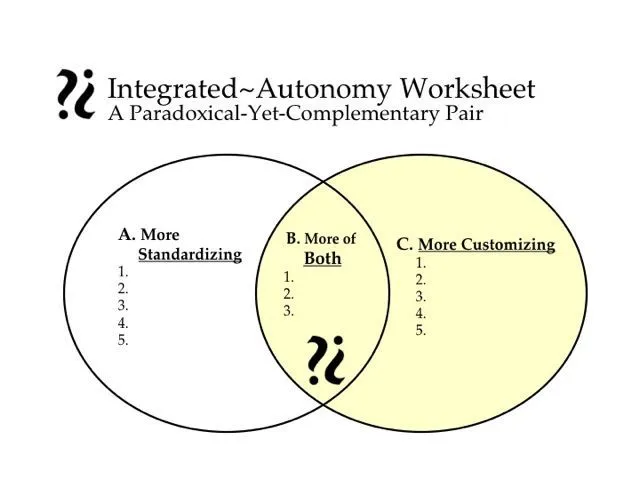
Diagram: Liberating Structures, Henri Lipmanowicz & Keith McCandless, liberatingstructures.com, CC BY-SA 4.0
Tips & Pitfalls
- The tension between central and local perspectives is often hidden. Name it explicitly.
- If a group gets stuck or argues, ask each side to adopt the other's viewpoint and argue from that perspective.
- As the session progresses, revisit the initial question "How are we integrating centrally while enhancing local autonomy?" Laughter and groans indicate progress.
Riffs & Variations
- Substitute "collaboration and competition" for "integration and autonomy."
- Use Min Specs to deepen the categories in the template.
Practical Applications
- Adapt guidance based on people's experience. For example, invite novices to honor the basics, while encouraging more experienced hosts to adapt an LS.
- Develop management contracts for small regional hospitals that combine central quality standards with local care pathways.
- Formulate national legislation that respects local implementation — useful for policymakers at all levels.
- In an agile environment, develop distributed version control systems while maintaining code integrity and accommodating local adaptations.
Online & Hybrid Facilitation
Online, use a 1-3-All configuration instead of 1-2-4-All.
Combining with Other Structures
Once you identify a solution that promotes both integration and autonomy, use Min Specs to refine the must-dos and must-not-dos for success. String with 9 Whys to connect a tactical solution back to the group's strategic goals.
Sources & License
Liberating Structure developed by Henri Lipmanowicz and Keith McCandless.
Based on the work of Keith McCandless and Nancy White, The Liberating Structures Fieldbook (2026), CC BY-SA 4.0.

Learn this in practice
Practice Liberating Structures with others: in the Online Fieldbook series (Nov–Dec 2026), the Immersion in Brussels, or tailored for your team.