
What Does This Make Possible?
In Drawing Together, participants use five simple symbols with universal meanings to share their challenges through drawings. This playful visual storytelling captures hidden knowledge—such as feelings, attitudes, and patterns—that are difficult to express with words. When logical and linear processes reach their limit, drawing can reveal new possibilities. This structure brings to life LS principle #7, Emphasize Possibilities: Believe Before You See.
Structural Elements — Min Specs
-
Structuring Invitation
"Who needs words when we have symbols? Let's ditch the dictionary and use five symbols to tell a story about a transition or challenge we are experiencing."
-
Space and Materials
Chairs with access to a table or writing surface for each participant. Paper and markers for each participant [shared digital drawing space]. [Figure 5.18 to display. Breakouts of two.]
-
Participation Distribution
Roles include [tech host], artists, and viewers. Minimum group size is two. Everyone is invited to create and share drawings.
-
Group Configuration
Alone, pairs, whole group
-
Steps and Time Allocation
- Intro: Share the structuring invitation. (1 min.)
- Symbol Introduction: Introduce the five symbols and their meanings, drawing each. Circle: wholeness, completeness, and the self. Rectangle: a foundation, offering support and stability. Triangle: goals, aspirations, and achievement. Spiral: change, transformation, and the cyclical nature of life. Star person (equidistant cross): relationships and connections. (5 min.)
- Symbol Practice: Participants practice drawing the symbols to get comfortable with them. (3 min.)
- First Draft: Participants weave the symbols into a visual story about a challenge they are facing or a transition they are making. No words allowed! (10 min.)
- Second Draft: Participants refine their drawings in a second draft, experimenting with size, placement, and color to add depth and drama. (10 min.)
- Silent Interpretation: Participants form pairs [breakouts] to share and interpret each other's drawings. The artist stays silent as the viewer interprets the story. After both share, they discuss their intended meaning. (5 min.)
- Remix and Repeat: Participants switch partners [new breakouts] and repeat the silent interpretation process twice. (5 min. per pair; 10 min. total)
- All-Together Sharing: Everyone returns to plenary. Ask a few people to share their drawings, then ask the group to reflect on common themes. (5 min.)
Diagrams & worksheets
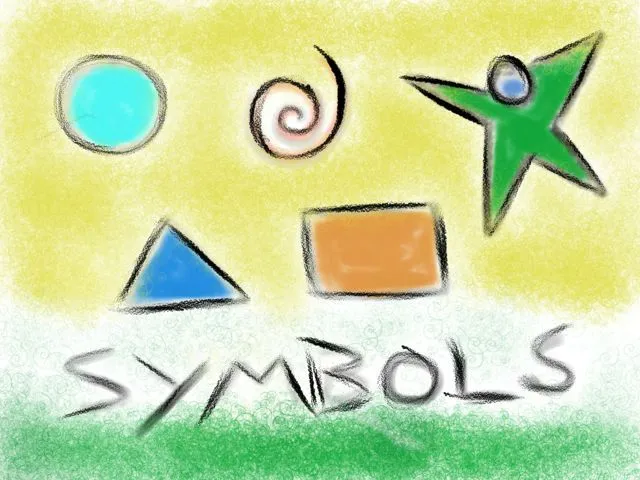
Diagram: Liberating Structures, Henri Lipmanowicz & Keith McCandless, liberatingstructures.com, CC BY-SA 4.0
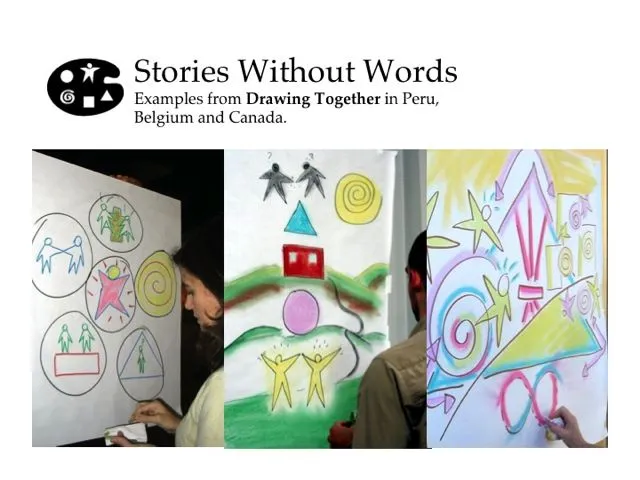
Diagram: Liberating Structures, Henri Lipmanowicz & Keith McCandless, liberatingstructures.com, CC BY-SA 4.0
Tips & Pitfalls
- Emphasize that drawing skills are not the objective and discourage perfectionism.
- Help participants accept whatever emerges, including emotions.
- Online, show the host drawing the symbols if possible.
Riffs & Variations
- Have one person use the symbols to visually map conversations during a meeting (then add words if necessary).
- Display participants' images in a gallery for a kaleidoscopic view of everyone's challenges.
- Return to the drawings when you reconvene as a group to help lift off from where you left off.
Practical Applications
- Use Drawing Together for a change of pace in a long meeting.
- To ease tension when perspectives differ.
- To reveal hidden relationships in a complex project.
- To bring a vision statement to life through images rather than words.
- For individual work on a high-stakes personal challenge.
Online & Hybrid Facilitation
There are two options: (1) Participants can draw on paper and share their work via webcam; in which case, instruct them to draw with a bold marker and turn off background effects that could blur or obscure their drawing; or (2) Use a shared digital whiteboard with prepopulated shapes. Note that this option may not work well on small screens.
Combining with Other Structures
To deepen self-discovery, string with Future–Present; Spiral Journal, and 9 Whys.
Combine with Other Structures
Sources & License
Liberating Structure developed by Henri Lipmanowicz and Keith McCandless. Dig deeper by exploring the work of cultural anthropologist Angeles Arrien and her book, *Signs of Life*.
Based on the work of Keith McCandless and Nancy White, The Liberating Structures Fieldbook (2026), CC BY-SA 4.0.

Learn this in practice
Practice Liberating Structures with others: in the Online Fieldbook series (Nov–Dec 2026), the Immersion in Brussels, or tailored for your team.