
Sequence Is the Skill: How to Design a String That Lands
Ask a first-time user for their favorite Liberating Structure and you get a name. Ask an experienced host and you get a sequence.
That's the craft. The structures themselves are public domain: free, documented, identical for every host on the planet. What separates a session that fizzles from one that shifts something isn't which structures you picked. It's the order you put them in. I've watched sessions fail using nothing but well-chosen structures, arranged wrong. That's also why the method doesn't undercut itself by being open. The building blocks are free. Building is a skill you earn.
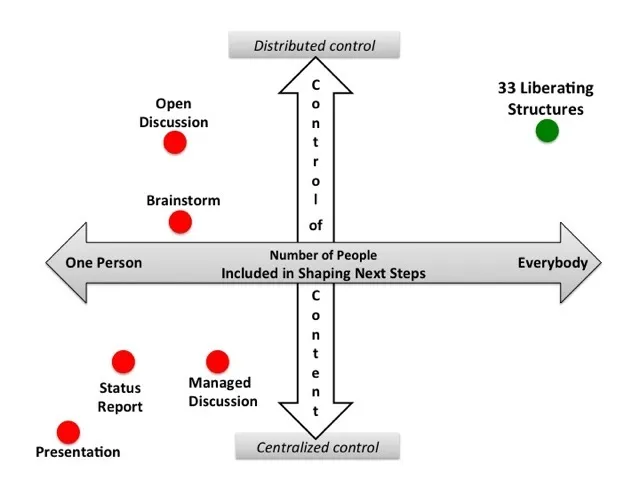
Diagram: Liberating Structures, Henri Lipmanowicz & Keith McCandless, liberatingstructures.com, CC BY-SA 4.0
Diverge Before You Converge
Every string that works opens wide, then narrows. Start with something that gets everyone thinking and talking: 1-2-4-All, Impromptu Networking, Mad Tea. Move into exploration. Only then move to choice and action.
Reverse that order and you're choosing from a thinner set of options, because half of them never surfaced. I've seen it happen with structures nobody could fault individually. The order was the whole problem.
Warm-Up Isn't Optional
New hosts skip the opening structure. They want to get to the point.
But a group that hasn't been activated doesn't go deep on command. A short 1-2-4-All or Impromptu Networking at the start isn't a nicety. It's a structural requirement for everything that follows. You lower the bar for speaking before you ask for something that takes nerve. Skip that step, and the room goes quiet exactly when you need it most.
The Hinges Carry the Weight
Strings usually break at the transitions, not inside the structures. Say the group just diverged wide with 25/10 Crowd Sourcing, and you want to move to Min Specs to narrow things down. Without an explicit bridge, that feels like a yank on the wheel.
The transition line, something like "we now have a lot of options, let's look at what's actually necessary," is a design element in its own right. When I prepare, I often spend more time on those hinges than on the structures themselves: how one flows into the next so the group never feels the seam.
Rhythm: Not Everything Can Run Hot
A string built only from high points wears people out. A hard divergence needs a quieter moment after it. Think of a concert's arc, not a playlist of separate tracks. Heard, Seen, Respected after a confrontational conversation. A short What, So What, Now What? to let something land.
The dip isn't a weakness in the design. It's what makes the next high point possible.
End on Ownership
The strongest strings close with a commitment, not a summary. 15% Solutions. A Wise Crowds round. A moment where everyone names what they'll do tomorrow.
Skip that, and the session becomes a good experience that doesn't survive the room. The last structure decides whether anything actually changes.
Plan Hard, Hold It Loose
Here's the apparent contradiction at the center of the craft. I put real time into the sequence beforehand: which structure, in what order, which hinges. But that plan isn't a score I play note for note.
Mid-session, I adjust to what the group needs right then: how the flow is running, what's happening in the room. Sometimes I drop a structure. Sometimes I add one I hadn't planned. That looks like improvisation. It runs on the opposite logic.
You can only deviate deliberately because you thought the sequence through in the first place. Skip the planning, and you can't adapt. You just drift. The plan is what earns you the freedom to let it go.
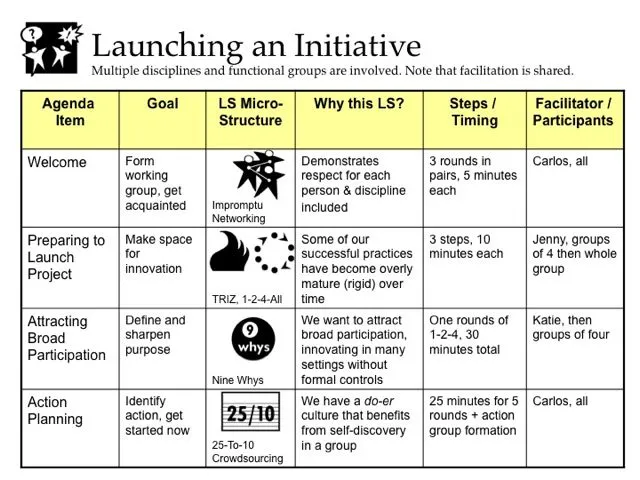
Diagram: Liberating Structures, Henri Lipmanowicz & Keith McCandless, liberatingstructures.com, CC BY-SA 4.0